
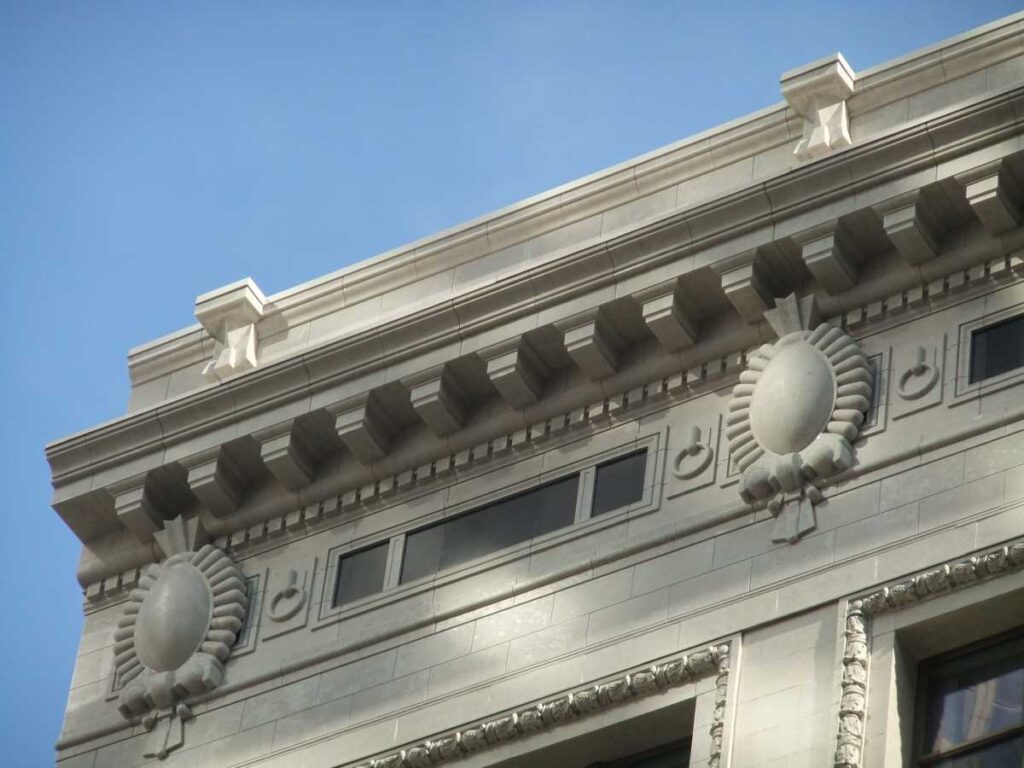
Recreating the Original Terra Cotta Cornice with FRP
One of the primary challenges of this historic restoration was accurately reproducing the original architectural details while reducing the weight of the new cornice and parapet assembly.
AFI manufactured a custom fiberglass cornice and parapet system spanning approximately 200 feet in width and 20 feet in height. The new architectural components were designed to replicate the appearance of the original terra cotta features while taking advantage of the flexibility and reduced weight of fiberglass reinforced polymer.
Unlike traditional terra cotta, which often requires numerous individual pieces, architectural FRP allows multiple decorative elements to be integrated into larger prefabricated sections.
This approach helped reproduce the historic appearance of the building while reducing the number of individual components required for installation.
Custom Architectural Details and Fiberglass Fabrication
The original building featured elaborate architectural ornamentation that played an important role in its historic appearance.
AFI’s custom fiberglass cornice incorporated several significant decorative elements, including:
Large architectural brackets.
Traditional dentil molding details.
Ornamental Ionic cartouches.
Decorative cornice profiles.
Carefully reproduced joint patterns.
Custom fiberglass parapet components.
Particular attention was given to replicating the appearance of the original terra cotta construction.
To maintain historical authenticity, AFI incorporated simulated joints into the fiberglass components. These decorative joints reproduced the visual articulation of the original terra cotta units while allowing multiple architectural details to be manufactured as larger FRP sections.
The result preserved the appearance of traditional masonry construction while using modern composite manufacturing techniques.
Advantages of FRP Cornice in Historic Building Restoration
Fiberglass reinforced polymer cornice systems offer several advantages for historic restoration projects, particularly when reproducing large architectural elements originally manufactured from terra cotta, stone, or other heavy materials.
Lightweight Architectural Components
One of the most important benefits of fiberglass cornice is its reduced weight compared to traditional terra cotta.
For The Residences at 668, the newly manufactured fiberglass cornice and decorative elements weighed significantly less than the original architectural components.
This reduction in material weight was particularly valuable for restoring decorative features near the roofline of a historic multistory building.
Accurate Reproduction of Historic Details
Architectural FRP can be molded into complex shapes, making it suitable for reproducing traditional cornice profiles, brackets, dentils, and ornamental elements.
AFI’s custom fabrication process allowed the original architectural details to be recreated while maintaining the proportions and appearance of the historic building.
Larger Prefabricated Sections
Traditional terra cotta construction frequently involves many individual pieces, each requiring positioning and attachment.
For this restoration project, architectural elements that would previously have consisted of thousands of individual terra cotta units were consolidated into larger fiberglass components.
This approach reduced the number of separate pieces and simplified the overall assembly.
Long-Term Durability
Properly designed and manufactured exterior FRP cornice systems offer resistance to moisture, corrosion, and environmental exposure.
Fiberglass cornice is therefore a practical material option for architectural restoration projects where maintaining historic appearance and long-term performance are important considerations.
Preserving Cleveland’s Architectural Heritage
The restoration of The Residences at 668 illustrates how modern fiberglass manufacturing can support the preservation of historic architectural design.
By recreating the original cornice and parapet, AFI helped restore an important element of the building’s historic appearance while supporting its transformation into modern residential use.
The completed fiberglass architectural components reflect the proportions, decorative details, and craftsmanship associated with the building’s original design.
This project also demonstrates AFI’s ability to manufacture large-scale, custom FRP architectural systems for complex commercial restoration applications.
Custom Fiberglass Cornice Manufacturing by AFI
Architectural Fiberglass, Inc. specializes in manufacturing custom FRP cornice, fiberglass architectural moldings, decorative brackets, parapet components, and other architectural fiberglass elements for historic restoration and new construction.
Our manufacturing capabilities allow us to reproduce intricate architectural details and develop custom fiberglass components based on project-specific designs, dimensions, and requirements.
Whether restoring a historic building or incorporating traditional architectural details into new construction, AFI provides custom fiberglass fabrication solutions for architects, contractors, developers, and restoration professionals.
Contact Architectural Fiberglass, Inc. to discuss your custom fiberglass cornice or historic architectural restoration project and request a quote.